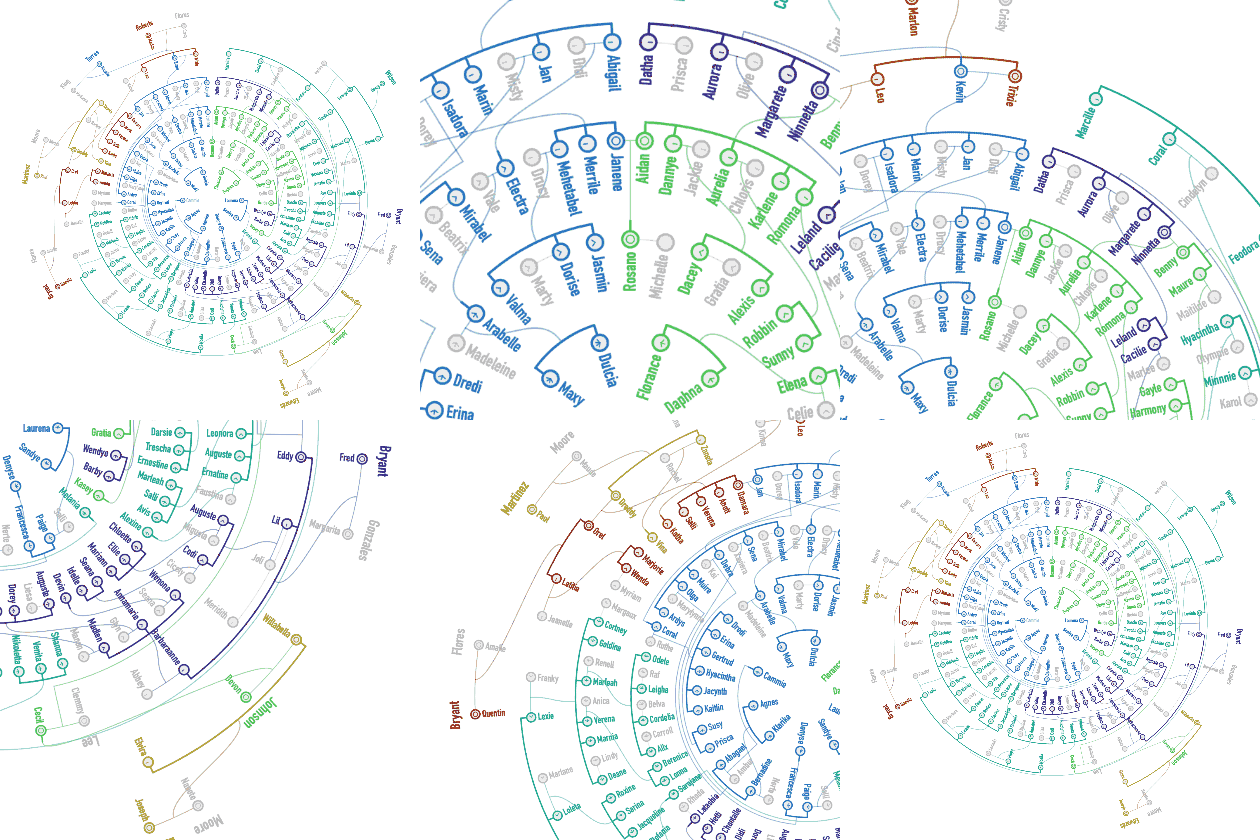
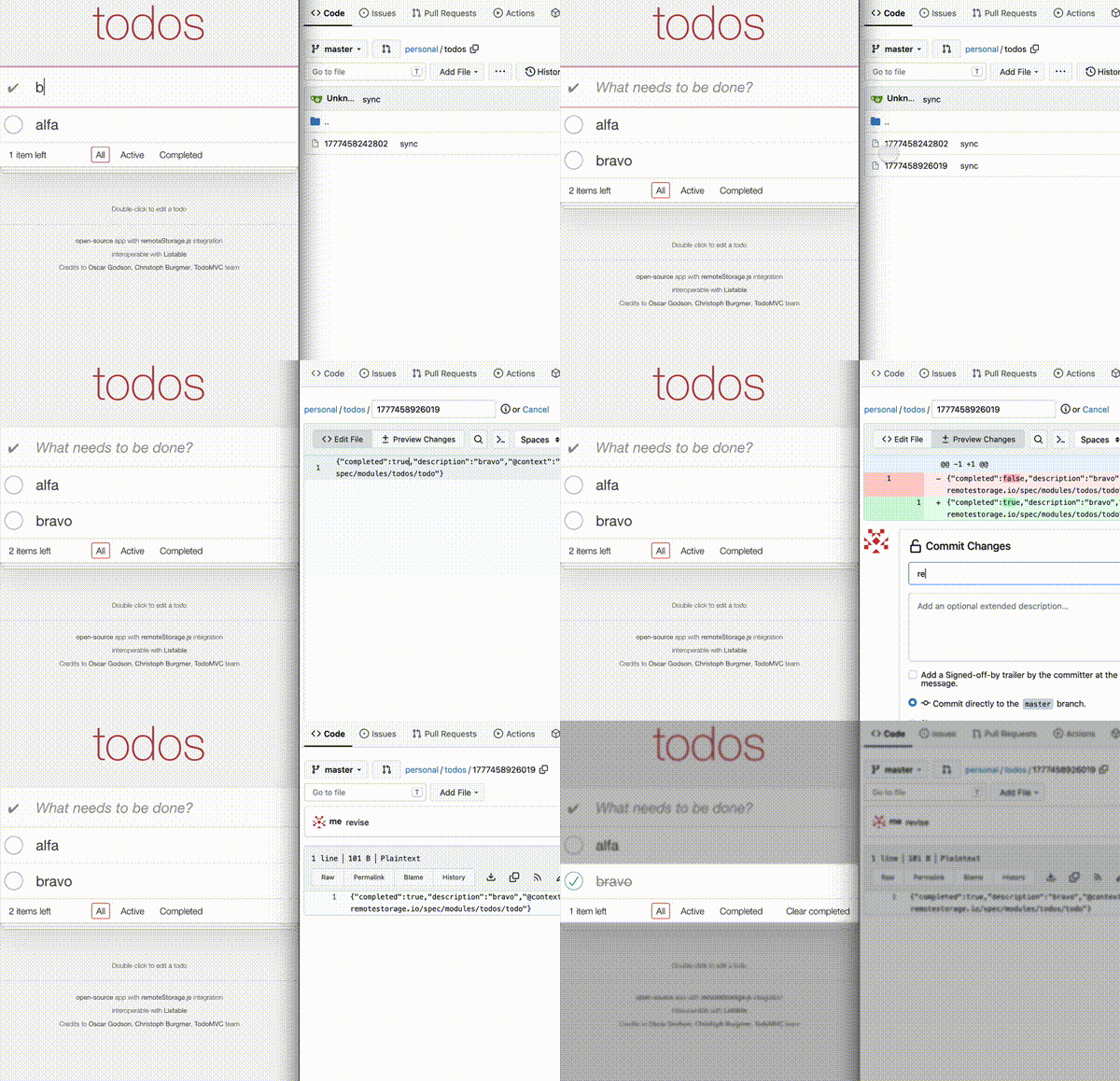
Still in Berlin; great to hang out a while here. Mostly working on projects, doing capoeira. Still less social than what I'm used to and starting to consider how much longer I want to stay in that mode.
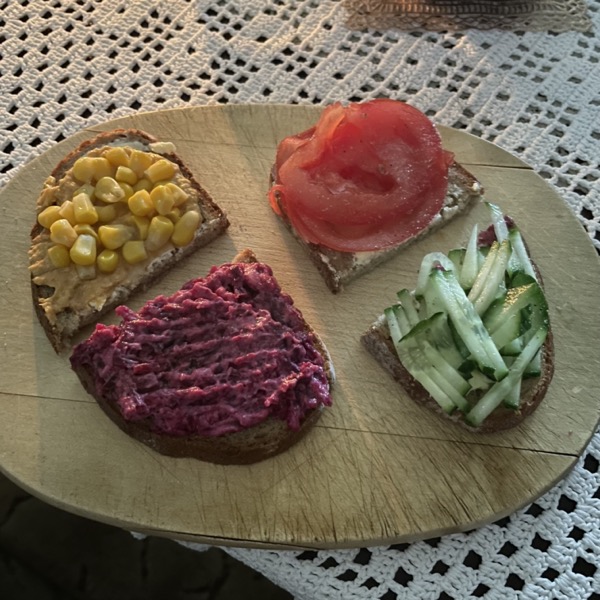
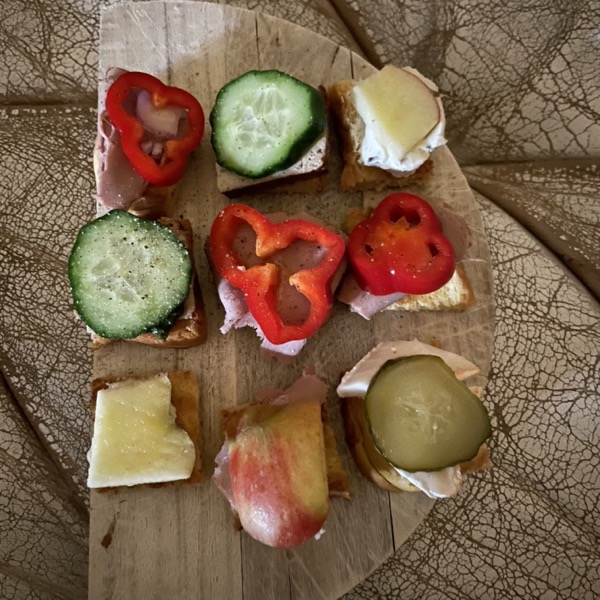
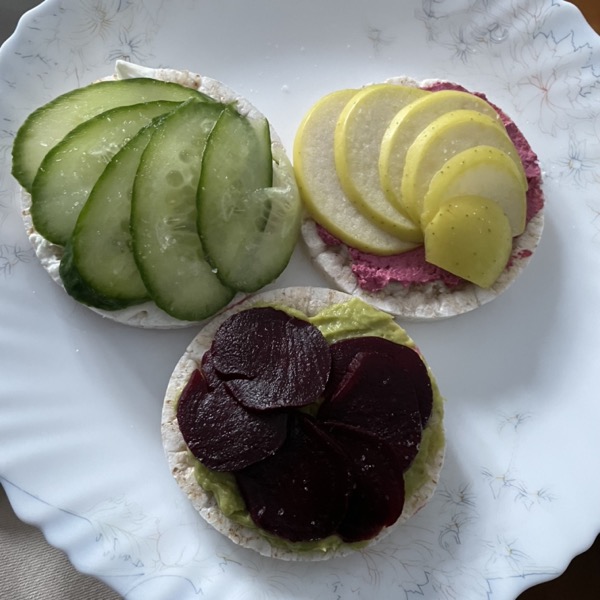
Happy to introduce Abendbrot ("evening bread" with stuff on it) into my routines; greatly simplifies 'figuring out what to eat'.
Taking far less photos means less photo management, and I'm enjoying that.
Noticing when I'm appeasing and trying to root this out of my relationships, which raises the bar for how good and clear I would like to feel with people in my circles.
My attention has recently shifted away from social media. In addition to avoiding scrolling memes, I tuned out of tweets, or what I call "high-frequency chatter". Notifications are now my "feed", and I'll happily engage with people about what I post, but my following attention is now mostly on those who publish slower on their own websites.
Forgive me reader for I have read 0 books since my last newsletter. I will offer book notes from my 2021 public journal, which is now online for the world's benefit.
[If you were reading a book where the pages progressively became more and more similar until you were reading the same page repeatedly, you would probably put the book down.]
['Alone in nature' is an oxymoron.]
[When you enter an area with birds, insects, or animals, they are listening to you completely as it may mean the difference between survival and death.]
Anger will get you started but it won't keep you going.
[As fewer people find themselves with the margin of privilege to switch off from the attention economy, attention itself might be the last resource we can control.]
[Bird watching is the opposite of looking up something online because you cannot request anything.]
[Online censorship exists without governmental intervention through flooding the stream with banalities that distracts from serious issues.]
['Be yourself' in language of advertising and marketing means 'be more of the consistent and recognizable habits and drives that are easy to target and appropriate'.]
[Avoid meticulously specifying everything. Help along rituals that emerge. Help everyone reflect on what they accomplished.]
[If one of your hand-raisers isn't ready to lead yet, let them do something small in scope to help build reflexes and experience.]
[Create together. Build together.]
[Tell an origin story that describes your personal journey (self), the collective journey (us), what people can do to get involved (now), plus 'why now?'.]
[Communicate your origin story wherever possible, online and offline, to inspire people to action.]
[We decided to use a Facebook group over a page because it would allow old, new, and potential customers could talk to each other.]
[Avoid 'having to know everything to do anything']
[Spreadsheets are approachable not because most people know how to add and subtract, but because that's what accountants and business people do.]
[End users are not 'casual' or 'naive': they are scientists, librarians, teachers, architects, and people that want to make serious use of computers without becoming professional programmers.]
[Conversational language is a poor medium of human–computer interaction because computers lack the context that we constantly refer to, as well as the ability to interpret context to derive meaning.]
[End-user programming languages are more motivating to learn when they are task-oriented: instead of making available only smaller primitives, provide higher-level abstractions that actually do complete jobs.]
Everyone always asks me, how do you have so much patience to engage with "these trolls/haters". I don’t do this for them. I do this for me. I share the earth with these people we call vile. Their opinions & actions affect me greatly. Closing my eyes & ears only hurts me.
[Gold medal: convince them. Silver: get them to understand you. Bronze: understand them. Always go for bronze first.]
[Popular communities can be categorized as either "libraries" (where visitors look for an answer, then leave without ever signing up), and "cafes" (where people of shared interests come to have open-ended discussions). Each requires different approaches to be successful.]
I also don't know what to do about the destructive extraction mining that sourced the minerals making up my computer. These human harms are almost surely greater than the theft of writing, yet I am happy to ignore them. I mention this not to wave away the wrongs, but to recognize that all my technology is bloody. I don't know how to remove myself from the entire system in such a way that my hands are clean. I don't know that anyone can do so in the interconnected age.
People who end up in positions of power are often not there because they’re particular profound, or strong, or even nefarious, but rather because they’re trauma-ridden vessels who offer the least resistance to the inhuman forces of our economic system, and who are therefore, almost evolutionarily, 'selected' by it.
More than 2 million people in the Philippines perform this type of "crowdwork", according to informal government estimates, as part of AI’s vast underbelly. While AI is often thought of as human-free machine learning, the technology actually relies on the labour-intensive efforts of a workforce spread across much of the global south and is often subject to exploitation.
every question I ask is turned into a thesis, the counter is created (antithesis). Two agents then take on those roles and the case is argued through several rounds (minimum of three, maximum of ten). A group of 12 agents then vote (with public reasoning) after each round - the first three rounds are merely indicative and there's also a zero round vote on the quality of the thesis / antithesis.
A judging agent then decides at the end of each vote whether the arguments are materially different and if there has been a successful conclusion. Without a successful conclusion then the game continues (again there must be at least 3 rounds). Both the arguing agents have access to the argument, the counters, the voters comments and votes. Each round they present a refined argument. A court recorder summaries the thesis, antithesis, the main arguments presented and which argument eventually wins (if any does).
[On the internet in 1993…] There was no advertising, and no talk of money. I met someone who said he wanted to make money online, and I tried to explain to him that that’s not what the internet is about. It’s a free helpful place where everyone contributes and benefits from others’ contributions.
[AI companies are so overexposed to debt and market correction that their success relies on everyone using it. When it isn't working for everyone, the next best thing is making usage mandatory. They can require it by crippling local computing power and supply to force people through cloud services.] Want storage? That'll be another $20/mo. Want graphics for games? Another $20. You want to perform data science and fit ML Models?! You're going to need the Professional plan, starting at $200/mo. It's a rent-seeker's dream.
Text is the most socially useful communication technology. It works well in 1:1, 1:N, and M:N modes. It can be indexed and searched efficiently, even by hand. It can be translated. It can be produced and consumed at variable speeds. It is asynchronous. It can be compared, diffed, clustered, corrected, summarized and filtered algorithmically. It permits multiparty editing. It permits branching conversations, lurking, annotation, quoting, reviewing, summarizing, structured responses, exegesis, even fan fic. The breadth, scale and depth of ways people use text is unmatched by anything. There is no equivalent in any other communication technology for the social, communicative, cognitive and reflective complexity of a library full of books or an internet full of postings. Nothing else comes close.
the need for realtime editing in applications is greatly exaggerated. Think about how rare it is to:
get two people to be in the same place at the same time
have a task where more than one person makes changes at a time
want other people peering over their shoulder while they work
Before bed: add 2x 500ml jugs of bread flour, 1 jug of warm water, quarter teaspoon of dried yeast, 2 teaspoon of salt, 1 tablespoon of rapeseed oil or olive oil to a bowl. Mix together with the handle of a wooden spoon. Cover and let rise overnight.
The dough is quite sticky, wet your hands to handle it. pull the edges of the dough to the center a few times to stretch the gluten. Split the dough, put in loaf tins or shape. Leave to rise again. Bake it in a hot oven for 40 mins.
BidWix is not a marketplace. It does not handle payments. It does not write contracts. It does not take a cut. It does one thing only: it helps two people land on a price, quickly, without stress, and with a result that feels balanced.
Instead of negotiating out loud, both parties enter a private limit price, once.
[Buyers enter their maximum offer, sellers enter their minimum ask. The numbers stay secret. There is no 'counter offer' or back-and-forth: it's one shot.]
[If a freelancer wouldn't accept less than 100 for a small task and a client could stretch to 900 if they had to, BidWix would suggest the geometric mean of 300, which is three times higher than the freelancer’s minimum, and three times lower than the client’s maximum. Both sides win by the same factor.]
[Running countries like a business means the shareholders (financial donors) are best served when the company (government) extracts as much as possible from consumers (you) while providing little in return.]
[Mechanical thinking conditions us into believing that things are separated so that it can sell us natural things as products we can buy repeatedly forever.]
[Delivery companies like Uber Eats and Wolt rely on 3rd party agencies to recruit and hire drivers as 4th party contractors. These agencies interact anonymously through WhatsApp numbers, make arrangements to pay in cash at sketchy locations (often less than anticipated), then regularly declare bankruptcy before starting the scheme again to avoid paying taxes or social security.]
[Transitioning to a cashless society implies moving away from state-issued money towards 'tokens' issued by private corporations. We currently trust their casino chips because they can be redeemed for fiat currency, but without cash this is no longer possible.]
[The laughs of my mother, grandmother, and grandfather sounded like music, and it's one of the reasons I wanted to be funny: to hear that beauiful music.]
communication and collaboration as tuning: all parties responsible for the interaction and supporting it to bring the best out of each other without overloading anyone
I see every one's project, and purpose, to be connected to all others as a piece of a grand puzzle. And my job in the last 2 years has been looking at each person, and finding where they fit, and when it works, they thrive, and the world thrives. Because the world needed them, and they needed it
"politically radical" means people have no stepping stones into your ideology?
social media
engagement-bait accounts love to weaponize Cunningham’s law:
"the best way to get the right answer on the internet is to post the wrong answer"
it's a lose-lose for the target because if you don't reply it allows misinformation to spread, if you do reply it boosts the post
tuning out of algorithmic feeds and advertising as if they're unwanted messages from unknown people.
tech
"non-technical users" → "jargon-free people"
LLMs have made me smarter because my distrust in them increasingly causes me to figure things out for myself
i have an impression that ai-assisted coding is so far most enjoyed by either people who can't debug anything, or, people who can debug absolutely everything
sounds
Listen as a distraction-free playlist, without accounts or sign up.
seems like the same material repeats for almost two minutes, but still interesting; cool "rising" sensation in the bass with these complex chord changes in the background
[Practice free association with your notes app by making a list starting with any word and following it with whatever comes to mind. Try to be non-judgemental. More important that it makes sense to you than to other people. When you're comfortable to try with a beat, you can just fill space with "uhh" or other rhythmic sounds and simply land on your next word to practice changing in time.]
Music training really trains you to break things down into manageable parts. Teaching well exposes the atomic elements of a practice so that you can find the right entry point for your level of skill or experience.
Italian voice actor Carlo Bononi was the voice of all of the characters on Pingu. A trained clown by trade, he used a theater technique called grammelot, which consists of "speaking" in a mix of babbled gibberish noises. He improvised all the voices live and unscripted.