
helping myself read
Growing up, I found reading a challenge because my mind would wander. I used to hope humans would invent more efficient forms of ingesting information (like video explainers or interactive experiences). I'm glad to not think that way anymore and for many years have maintained the belief that books are the greatest technology humans have invented.
Although I aspire to go through them like Cookie Monster eats cookies, I'm not there yet, and thought to share some things that helped me along the way.
tracking
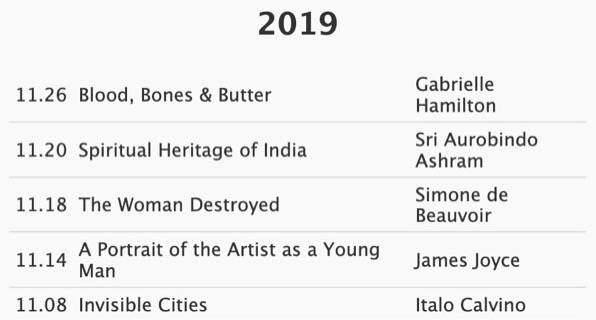
Since 2019, I list books I've read in my klog as it motivates me to read more; the name is from "book log" in the way that blog is from "web log", but also has this nice whiff of "cramming stuff into your brain". Sometimes it felt superficial, but I tried to stay conscious of why I'm reading and it's generally been useful.
notes
Since maybe 2009, I've taking notes on readings. I actually used to write out quotes by hand until going digital in 2019 and at some point will incorporate them into my klog.
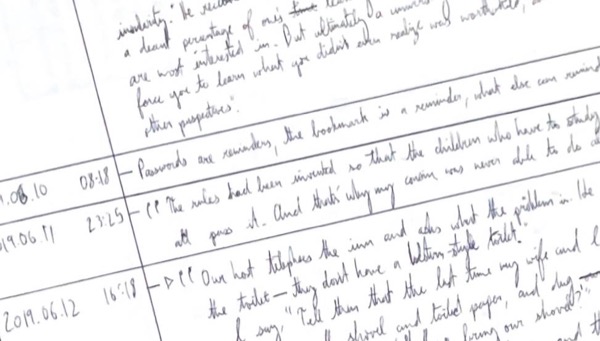
Some part of me naively hopes to eliminate reading more than once if I've taken the right notes, capturing ideas forever and making it easier to either remember or find, but that probably doesn't happen as imagined.
I try to paraphrase in my own words wherever possible as it helps me to clarify what is communicated. Sometimes the author says it better, sometimes I can, but the focus is to note what's meaningful for me.
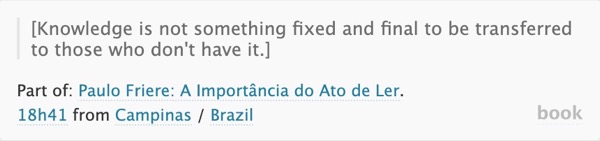
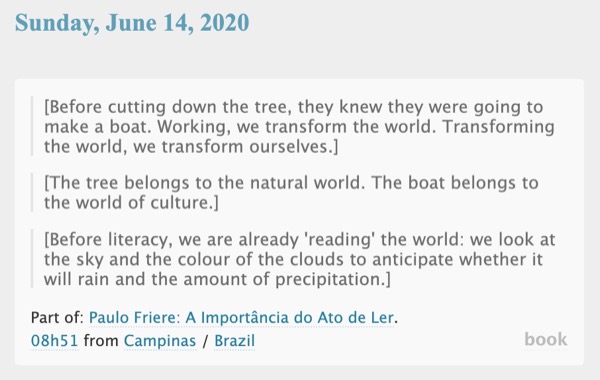
Recently, I've linked each klog entry to my quotes and paraphrases (inspired by Derek Sivers' book notes page).

skip
I also note books I skip because that's part of reading too and it provides a useful indicator of what someone with my perspective finds relevant.

This came after a long phase of feeling forced to read every word from start to finish, probably by some idea that I should be able to read and understand anything. My reading progress would stall when I landed on something uninteresting, and some imaginary academic finger would wag to guilt me into ingesting IMPORTANT CANON. But one of Nassim Nicholas Taleb's books snapped me out of it, and instilled morefreedom to go in and out of various books, to not finish.
rights
I would finish by saying that a large part of what helped me read more is simply having a different mindset.
Last year I encountered a list in Portuguese called "rights of the reader", which seems to be paraphrased and translated from a book by Daniel Pennac; there's even an illustrated PDF of the list.
- the right to not read
- the right to skip pages
- the right to not finish a book
- the right to start anywhere or read in any order
- the right to read whatever you want
- the right to read wherever you want
- the right to not talk about what you've read
- the right to read again
- the right to escape real life
- the right to read aloud
I know I needed to hear this, maybe you know someone who also does?
Source Also on Mastodon Bluesky Twitter Facebook Nostr Threads Instagram LinkedIn